
2015 Study: Understanding How Code-Switching Is Learned
Abstract
Code-switching is a natural human practice involving adjustments to speech, appearance, behavior, and expression across different social, educational, and professional environments. While adaptation can support effective communication and connection, it can also create challenges when individuals feel pressured to modify how they present themselves to meet expectations or gain acceptance.
George Paasewe's research explored an important question: How do individuals learn to code-switch?
Through qualitative interviews and focus group discussions involving 35 participants, the study identified three primary pathways through which code-switching is learned: observation, interaction, and instruction.
The findings offer insight into how individuals recognize expectations, interpret social cues, and develop strategies for navigating different environments. They also raise important questions about the relationship between adaptation, identity, authenticity, and belonging.
Today, this research informs broader conversations about how educational institutions and organizations can create environments where individuals navigate expectations confidently while remaining grounded in who they are.
Exploring the Expectations That Shape Human Behavior
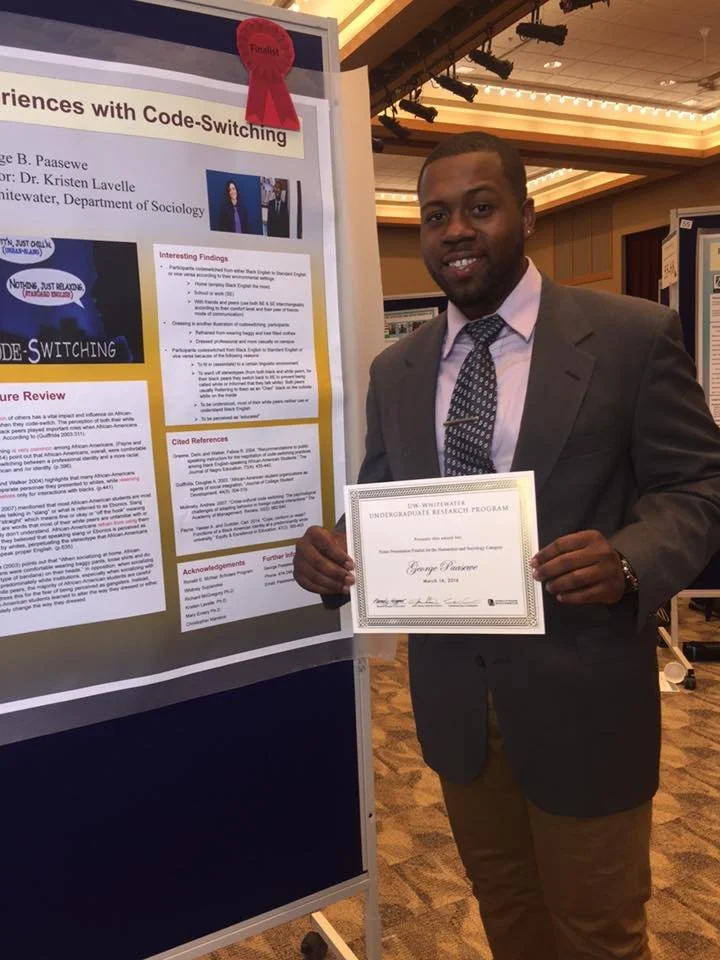
During the 2015–2016 academic year, George Paasewe conducted an Institutional Review Board-approved qualitative research study at the University of Wisconsin–Whitewater.
The research examined how college students learned to adapt their communication, behavior, and self-expression in response to expectations within their academic and social environments.
University settings offer opportunities to explore these experiences because students regularly navigate classrooms, peer relationships, professional preparation, and interactions with individuals whose expectations may differ from their own.
The study sought to understand how these expectations are recognized, learned, and reinforced through everyday experiences.
At its core, the research examined a fundamental aspect of human interaction: How do we learn when, where, and why to adjust how we present ourselves?
Gap Identified: Understanding How Code-Switching Is Learned
Existing scholarship has explored why individuals code-switch, the benefits and challenges of adaptation, and the relationship between code-switching, communication, and identity.
Paasewe's research examined another important dimension: the learning process behind code-switching.
How do individuals develop the awareness and behaviors necessary to navigate different social expectations?
The study identified three primary learning pathways:
Observation: Individuals learn by watching how others communicate, behave, and respond to expectations in different environments.
Interaction: Individuals develop an understanding of social expectations through personal experiences, relationships, feedback, and everyday encounters.
Instruction: Individuals receive direct or indirect guidance about appropriate communication, behavior, appearance, and self-expression.
Together, these findings provide a useful framework for understanding how individuals recognize and navigate expectations.
They also encourage reflection on a broader question: When does adaptation represent personal choice, and when does it become a response to pressure?
Research Methodology: Participants
In November 2015, Paasewe began recruiting undergraduate students at the University of Wisconsin–Whitewater for a qualitative study examining the learning processes associated with code-switching.
Recruitment methods included email outreach, social media, and word-of-mouth communication.
The study included 35 undergraduate participants between the ages of 19 and 24.
Participants contributed their perspectives through individual interviews or focus group discussions, allowing the research to examine both personal experiences and shared patterns.
Pseudonyms were assigned to protect confidentiality and encourage open, thoughtful participation.
Data Collection: Interviews, Focus Groups & Research Questions
George Paasewe employed a qualitative research approach combining in-depth individual interviews and facilitated focus group discussions to explore how code-switching is learned, practiced, and experienced. The study included 14 individual interviews and two focus groups, with 11 participants in the first group and 10 in the second.
These discussions provided opportunities for participants to share personal experiences, examine social expectations, and reflect on how different environments influence communication, behavior, and self-expression. The research explored how individuals recognize unspoken expectations, develop adaptive behaviors, and navigate the relationship between authenticity and social acceptance.
The following questions reflect the central themes explored throughout the research:
Question 1: How does your communication style change across different social and professional environments?
Question 2: In what situations do you feel most comfortable communicating naturally and authentically?
Question 3: What motivates individuals to adjust their communication, behavior, or self-expression?
Question 4: When and how do individuals learn to code-switch?
Question 5: What aspects of your communication, appearance, behavior, or expression change when code-switching?
Question 6: Does code-switching occur consciously, unconsciously, or through a combination of both?
Question 7: Do you view code-switching as an advantage, a challenge, or both?
Question 8: What environments or circumstances create the greatest pressure to adapt?
Question 9: Have you experienced judgment based on how you communicate or present yourself?
Question 10: Have you encouraged others to adapt their communication or behavior?
Question 11: How do the expectations and perceptions of others influence your decision to code-switch?